On November 11th The Bulgarian Chapter of the Project Management Institute (PMI) brought together over 400 delegates for their annual conference, #PMDayBulgaria2016, under the theme “Vision for success. Mission for excellence”. OnboardCRM contributed to the program, which focused on approaches for Effective Project Delivery in the current market environment driven by globalization and digitalization.
OnboardCRM is a leader in digital transformation consultancy and project management excellence, actively participating in the PMI community in Bulgaria and best practice sharing. One of our PMP certified project managers, Iliyana Zaharieva is elected 2016-2017 PMI Bulgaria Chapter Vice President of Development Projects & Volunteering. Iliyana has led OnboardCRM digital evolution team’s participation in the event and will be organizing the PMDay 2017 next year.
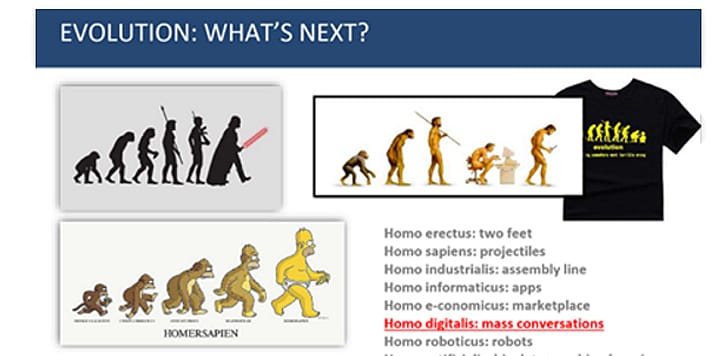
Our Chief Digital Evolution Officer, Levent Korkmaz delivered a thought-provoking keynote on the need for digital self-transformation for leaders and project managers, touching on evolutionary trends and the need for social inclusion and adaptive skills for survival in the digital age.
Levent Korkmaz comments:
Technology is accelerating human evolution: because of sharing and conversations, the information revolution has disrupted consumerism and globalization. Selfie addict millennials say: we share therefore I am! Internet and mobile devices augment our social capabilities and enable mass conversations. Once the robot dreams of Asimov are realized we may no longer have to work, will we make it to the last level of evolution and do digital humans dream of Homo Universalis?

Entropy (too much information) leads to chaos more than it helps society to self-organize and counteract/control the uncontrollable, unpredictable, unforeseeable effects of digital revolution. Half of Fortune 500 companies gone bankrupt since 2000, financial/security/governance and sustainability crises also prove how challenging it is for evolving, adaptive ‘organisation’ to emerge successfully at the edge of chaos and order.
We don’t seem to have the leadership skills to rise up to the challenge of leading the digital evolution and adaptation strategies for the human project to succeed. Hierarchical mindset is triangular and top-down, while what we need is organic circular teams to manage projects based on competence and capabilities instead of risk control and predictability.
Also, the experience of old age wisdom is discarded and as digital skills are not updated through lifelong learning, older generations are excluded from the information society: I say “better late than never” and propose to include everyone in wise decision-making (common sense vs expert opinion). Even startups, for example, should consider thinking like “endups” and seek advice from veterans.
We see clearly that leadership is lacking and lagging in the emerging digital society, and mass manipulating opportunism is the only success/failure story with the deployment of twitter bots and facebook algorithms accused of creating “echo chambers”. In the meantime, there are very few leaders in enterprises who are willing to self-transform into digital role models. I am afraid they must travel and transform every step of the way, showing the way is not enough, they must also walk the talk. Look for the Chief Digital Officer or Chief Data Officer in your organization, big data scientists, and artificial intelligence leaders, have you got any? Or how many of your senior managers actually use social media and engage with the new brave übersocial world?
Homo Economicus must evolve into Homo Digitalis before the arrival of Homo Artificialis. Facebook, Microsoft, Amazon, IBM come together for this purpose of governing better the future of Artificial Intelligence, as the invisible question remains: “Does the Future Need Us?” We must find the answer before it’s too late if we miss the chance to spur a Digital Renaissance.
I think the key to the future is combining leadership and governance, and self-organising forms of competitive collaboration (adaptive innovation ecosystems) for the survival of the (Homo Economicus) species.