It’s been a year since Gartner announced the rise of the “Chief Data Officer” and predicted that 25% of large global enterprises will have a CDO by 2015 -sitting next to the traditional CIOs, especially in heavily regulated sectors like Finance, Insurance and Government. [i] The third digital hero is yet another CDO: the “Chief Digital Officer” that will steer the corporate ship through the foggy fjords of digital transformation. The Data Office is mandated by data governance, security and privacy regulations as well as analytics and data science whereas the Digital Office has going-to-market, change management and digital channels on their agenda. All of them relying on SaaS (Software as a Service) paradigm and cloud computing: ERP and CRM solutions are driving the digital enterprise profitability and 2015 is the year of mobile.
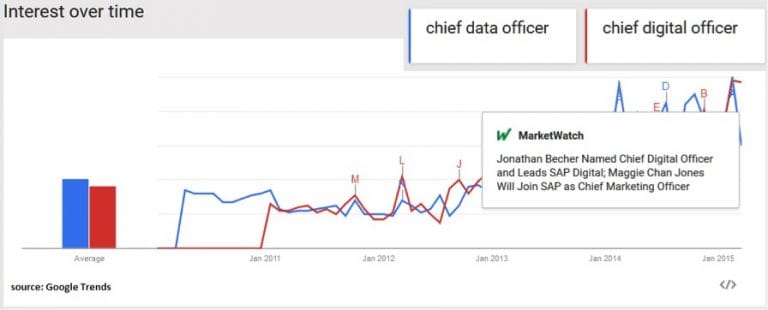
CIOs will make sure that all systems go for everyone: moving the data-hungry users from corporate servers to personal devices, consuming freely downloadable applications that are increasingly mobile and subject to unpredictable BYOD (Bring Your Own Device) rules and processing power. Buying solutions rather than building, managing contractors and consultants rather than hiring in-house talent. Not knowing where in the world the servers are located, as long as the big data streams keep flowing. Extending the enterprise beyond employees, forging partnerships and alliances in cloudy ecosystems.
Chief Data Officers: the art and science of creating value out of big data
Data is already driving all Marketing and Sales processes, and Service has just joined the cloud capturing large amounts of interactional data. The value of data as a corporate asset is undeniable, but the Data Officers can now tap into the full potential of data operationally, analytically and strategically, controlling the source, quality and distribution of data and being able to analyze it on the cloud.
Chief Digital Officers: new channels, new markets, new devices, all digital
Digital Revolution has completely transformed all business critical processes and the way interactions with customers and the transactions are handled “online”, most of the time through agents or middleware. Social Media, Mobile Revolution, Internet of Things promise to open even more channels that are beyond the reach of mortal employees, who need to adopt to new ways of working and new tools of trade. Changing management and managing change, the digital officer is charged with transforming marketing, sales and service practices that can handle large amounts of digital transactions.
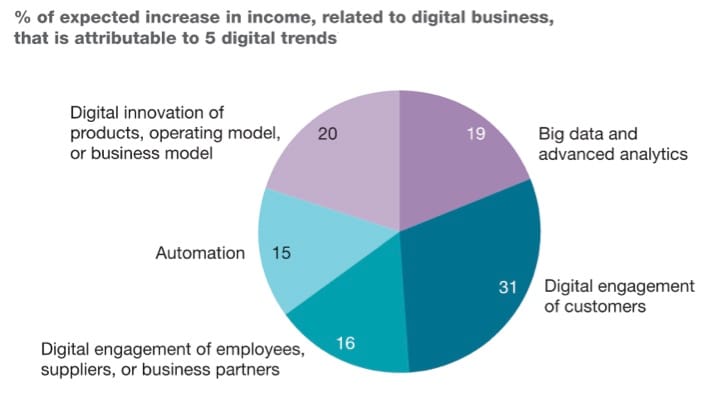
And the impact of their tandem? Expected revenue from the three chiefs working together is quite high: it almost looks like profitability of the whole digital business depends fully on their ability to reap the benefits of cloud computing:
Innovation is included in the price
Three generations of cloud computing are the major enablers for such a profitable transformation and resource sharing: SaaS and later generation PaaS (Platform as a Service) supported by IaaS (Infrastructure as a Service, currently growing 50% per annum) provide the economies of scale and the agility to execute “on demand”. As the storage costs decrease, larger databases can be hosted on the cloud where technical innovation is served for free. The SaaS leader Salesforce.com has been nominated the most innovative company by Forbes magazine for four consecutive years, undoubtedly confirming that the service includes innovation. Enabling the social enterprise that can host “ideas” and “communities” next to customer data also enables digital engagement with customers, partners and employees alike.
2015 Year of Mobile and Analytics Cloud in the making
Salesforce.com is currently busy pushing the boundaries of mobile data applications and catching the next “wave” of data science: just after Salesforce1 “Lightning” was released as a point-and-click app builder on mobile devices, Analytics Cloud was also released (currently available only for iPhone). An unexpected partnership with the old rival Microsoft has brought the (Excel based) Power BI into the digital arsenal of SaaS analytics users, and more “predictive analytics” can be expected following the recent purchase of the big data analytics platform RelateIQ.
2015 will be an exciting year for the future CDOs waiting to be appointed.
LEVENT KORKMAZ
Sources:
[i] Debra Logan, “CIO Advisory: The Chief Data Officer Trend Gains Momentum”, 13 January 2014 https://www.gartner.com/doc/2648615/cio-advisory-chief-data-officer
Same prediction was repeated by Janessa Rivera on 2 February 2015: “Gartner Says CIOs and CDOs Must ‘Digitally Remaster’ Their Organizations” just before the Enterprise Information & Master Data Management Summit 2015 in London http://www.gartner.com/newsroom/id/2975018